
What Is Polyvagal Theory? (Without the Fancy Words)
Aug 17, 2026
Understanding why you sometimes feel calm, sometimes overwhelmed, and sometimes just want to hide under a blanket.
Heard the term "Polyvagal Theory" but have no idea what it actually means? Here's a simple, practical explanation of how it relates to stress, safety, connection, and your nervous system.
Let's be honest...
Polyvagal Theory sounds like one of those words people throw around at wellness retreats while you're standing there wondering if you accidentally walked into a university lecture.
I remember hearing it for the first time and thinking...
"Poly... what now?"
If you've ever felt the same, you're definitely not alone.
The good news?
It's actually much simpler than it sounds.
And once you understand it, you'll probably start looking at yourself—and everyone around you—a little differently.
So... what actually is Polyvagal Theory?
Polyvagal Theory is a way of understanding how our nervous system responds to safety, connection, and danger.
It was developed by neuroscientist Dr. Stephen Porges in the 1990s as a framework for understanding how the vagus nerve influences our physiological responses to stress, safety, and social connection.
Rather than asking,
"What's wrong with me?"
Polyvagal Theory encourages us to ask,
"What is my nervous system responding to right now?"
That one small shift can change everything.
Meet your vagus nerve.
No...
It's not a Harry Potter spell. The vagus nerve is actually the longest cranial nerve in your body.It travels from your brain all the way down through your face, heart, lungs, digestive system and several other organs.
Think of it as one of the body's biggest communication highways. It's constantly sending information between your brain and body.
Sometimes that information says...
"Everything's okay."
Other times...
"We need to prepare for danger."
And the incredible thing is...
Much of this happens automatically.
You don't consciously decide to make your heart race before an exam.
Or get butterflies before a difficult conversation.
Or suddenly lose your appetite when you're stressed.
Your nervous system has already made the call.
Your body is always asking one question.
Not...
"Am I successful?"
Not...
"Do people like me?"
Not even...
"Did I reply to that text?"
The nervous system's favourite question is much simpler.
"Am I safe?"
Every second of every day your body is collecting information.
From your environment.
From other people.
From your own thoughts.
From your memories.
From your physical health.
All of that information helps determine how your nervous system responds.
When Your Body Doesn't Feel Safe
Your nervous system has one job: to protect you.
When it senses danger—whether that's physical danger, emotional stress, conflict, overwhelm, or prolonged pressure—it automatically shifts into survival mode.
There are a few different ways this can look.
Fight or Flight
This is your body's "let's do something about this" response.
It prepares you to face the challenge or get away from it as quickly as possible.
You might notice:
- anxiety
- racing thoughts
- irritability or frustration
- feeling restless
- a racing heart
- wanting to escape
- trouble concentrating
- constantly keeping busy
- difficulty relaxing
- trouble sleeping
Your body is essentially saying,
"Something doesn't feel safe. Let's be ready."
Freeze
Sometimes, instead of speeding up, your nervous system does the opposite.
It slows everything down to conserve energy and protect you.
This can feel like:
- feeling stuck
- zoning out
- brain fog
- feeling disconnected
- struggling to make decisions
- wanting to avoid everything
- feeling emotionally numb
- procrastinating
- finding it hard to get started
Your body is saying,
"This feels like too much right now."
Fawn
Sometimes our nervous system tries to stay safe by keeping everyone else happy.
You might notice yourself:
-
saying yes when you want to say no
-
apologising constantly
-
avoiding conflict
-
putting everyone else's needs before your own
-
worrying about disappointing people
-
struggling to set boundaries
-
feeling responsible for everyone else's emotions
Your body is saying,
"If everyone else is okay, maybe I'll be safe too."
And here's the important part...
None of these responses mean you're weak.
They don't mean you're dramatic.
They don't mean you've failed.
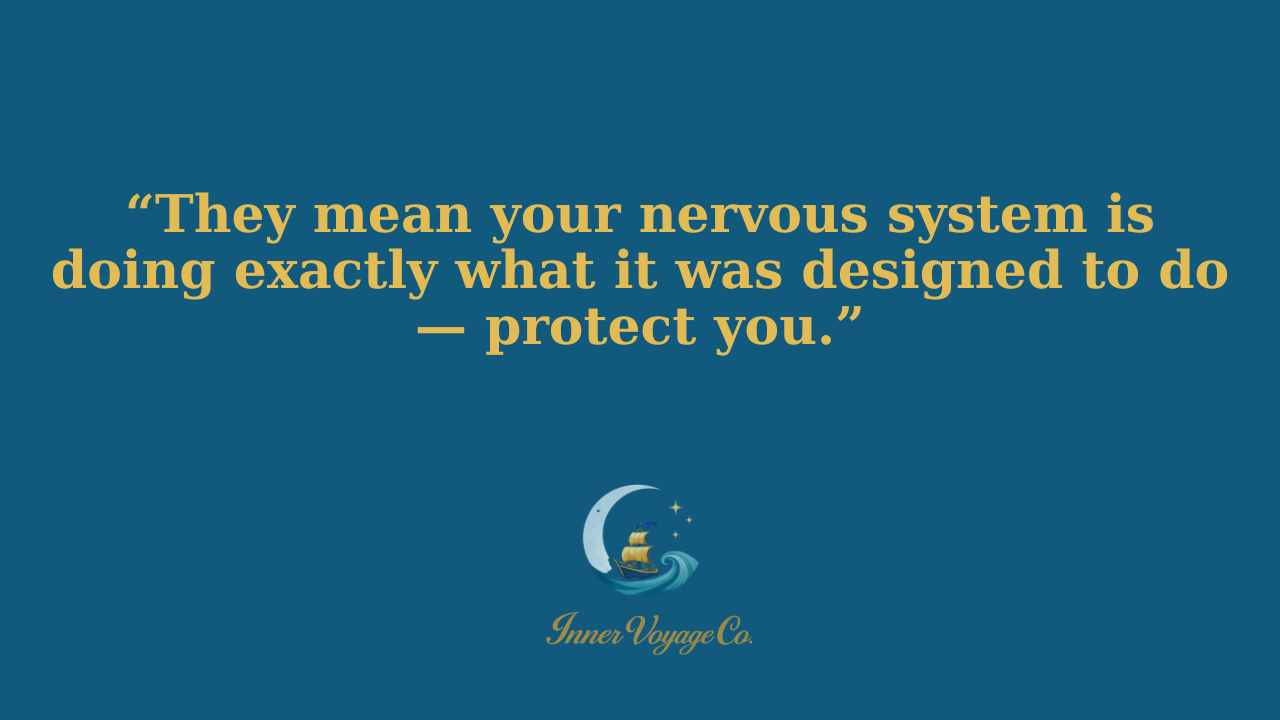
They mean your nervous system is doing exactly what it was designed to do—protect you.
The goal isn't to stop these responses from ever happening.
The goal is to become aware of them, understand them, and gently help your body find its way back to feeling safe again.
Here's something I wish more people knew.
These states are not personality traits.
You're not:
- "An anxious person."
- "An angry person."
- "A lazy person."
- "Too emotional."
Your nervous system moves between different states throughout the day depending on what it perceives.
That's completely normal.
The goal isn't to stay calm 100% of the time.
That would be impossible.
The goal is to become aware of what's happening and learn how to gently support yourself back towards regulation.
So... how do we support our nervous system?
The beautiful thing is that safety isn't only created by huge life changes.
Sometimes it's found in very ordinary moments.
Things like:
- taking a slow breath
- drinking a glass of water
- eating a balanced meal
- spending time outside
- talking with someone you trust
- listening to calming music
- stretching your body
- laughing with friends
- getting enough sleep
None of these seem life-changing on their own.
But together?
They send repeated messages to your nervous system that say,
"You're okay."
And those messages matter.
One thing I hear all the time...
People say,
"I know I should breathe more..."
"I know I should slow down..."
"I know I should eat better..."
Knowing and doing are two different things.
Supporting your nervous system isn't about becoming perfect overnight.
It's about creating small moments of consistency.
One breath.
One meal.
One walk.
One early night.
One kind conversation with yourself.
Those little moments become habits.
Those habits become resilience.
Before You Go...
If there's one thing I hope you remember from today's blog, it's this:
Your nervous system isn't overreacting because it's weak.
It's reacting because it's trying to protect you.
Sometimes it's just working with information that's become a little outdated.
The good news?
Our nervous systems are adaptable.
With patience, repetition, and support, they can learn that safety exists again.
And honestly...
That's a pretty incredible thing.
Further Reading
Stephen Porges – The Pocket Guide to Polyvagal TheoryDeb Dana – Anchored: How to Befriend Your Nervous SystemPolyvagal Institute – Educational resources on Polyvagal TheoryHarvard Health Publishing – Articles on stress, the autonomic nervous system, and wellbeing.
If today's blog resonated with you, don't let it stop here. Understanding your nervous system is a beautiful place to begin, but lasting change comes from gently putting that knowledge into practice. That's exactly why I created my nervous system resources—to help you move beyond simply knowing what to do, and start creating small daily habits that help your body feel safe, supported and calm.
Whether you're looking for a quick reset or a deeper dive through my 30 Day Nervous System Reset, I'd love to help you get there.
Explore the 30 Day Nervous System Reset →
Because you deserve to feel good in your own body.
Until next time...
Take a deep breath. Drink the water. Eat the lunch. Go outside. Be kind to yourself.
Your nervous system is doing its best, and honestly... so are you.
See you in the next blog.
 Your past explains you. It doesn't define you.
Sarah is a Polyvagal Therapy Practitioner, trained chef and the founder of Inner Voyage Co., helping people support their nervous system through simple, practical daily habits including the food they eat.
SUBSCRIBE FOR WEEKLY SUPPORT
Practical tips to help your nervous system feel calm, supported and steady — delivered straight to your inbox.
We hate SPAM. We will never sell your information, for any reason.